 Chat with us
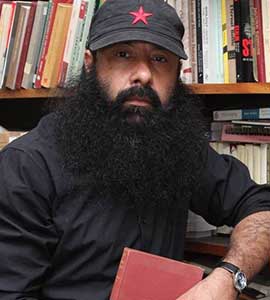
Manu Kant is a writer, journalist, satirist and working-class poet but above all, a Marxist-Leninist. Born in Patiala, Punjab and brought up in Chandigarh, he studied journalism at the Lomonosov Moscow State University in Moscow from 1987 to 1993, during the final years of the Soviet Union. The intellectual climate of that period and the enduring traditions of Russian literature and revolutionary thought left a deep imprint on his world view. Russia remains close to his heart, not as nostalgia, but as a living connection to a people and a historical experience that shaped his understanding of society.
Over the decades, he has written essays, satire and political commentary for newspapers and journals including The Tribune, The Indian Express, The Pioneer and the Kolkata-based weekly Frontier, founded by Samar Sen. His writing seeks to combine literary expression with a materialist understanding of society and history. He is the author of fifteen books spanning satire, political reflection and literary commentary, including Chandigarh: The Urban Poor — A Street Diary (Poems, 2015–2025), Mother, and The Mad, Mad, Mad West: A Satire on Uncle Sam's War on Russia.
Kant's intellectual outlook is shaped by the traditions of scientific socialism and the broader history of revolutionary struggle. He draws inspiration from Karl Marx, Friedrich Engels, Vladimir Ilyich Lenin and Joseph Stalin, and remains committed to the historical mission of the working class. He writes from the standpoint of the working class and opposes US imperialism and Israeli Zionism as expressions of monopoly capital and systems of exploitation and domination. He also opposes racism in all its manifestations—whether in the form of colonial attitudes, caste-like hierarchies, anti-Black racism, xenophobia against migrants, or everyday social discrimination—viewing it as a tool historically used to divide working people and sustain systems of exploitation.
His sympathies are not abstract. They extend to the struggles of peoples across continents—Russians, the Indian masses, Mayans, Incans, American natives, Africans, Asians, and working-class whites—linked by shared histories of labour, dispossession and resistance. From Toussaint Louverture and John Brown to Ernesto “Che” Guevara and Bhagat Singh, and to African leaders such as Patrice Lumumba and Thomas Sankara, he sees a continuous thread of anti-colonial and anti-imperialist struggle in the modern world.
The history of popular resistance, from medieval peasant uprisings to modern working-class movements, occupies an important place in his writing and thought. In literature and criticism, he is influenced by the Russian democratic thinker Vissarion Belinsky and the broader tradition of Russian cultural and revolutionary writing. His outlook is grounded in the lived experiences of the oppressed—workers, peasants, and marginalized communities across India and the world—whose struggles continue to inform his moral and intellectual commitments.
Manu Kant adheres to socialist realism in his poetry, pioneered and practised by Maxim Gorky, Bertolt Brecht and others.
Alongside his writing, Kant has spent decades building a personal collection of Marxist and progressive literature, including rare works on revolutionary history, Soviet culture and the international labour movement. His engagement with books and ideas reflects a lifelong effort to understand and articulate the forces shaping society.







Book Bazooka Publication बुक बज़ूका पब्लिकेशन
