 Chat with us
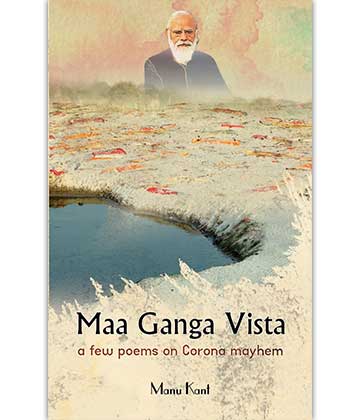
Maa Ganga Vista: Poetry of Grief, Anger and Class Truth
Maa Ganga Vista is not a polite book. It does not try to be literary in the elite sense. It speaks in a raw voice. It comes from the ground—cremation ghats, hospital queues, and silent homes broken by the COVID-19.
This itself is its biggest strength.
In times of crisis, many writers become cautious. They soften reality. They hide behind abstract words. But here, the poet refuses to hide. He names the horror. He names the system. He names the ruler—Narendra Modi—as a symbol of the present order.
From a Marxist–Leninist–Stalinist point of view, this directness is important. Literature must not escape reality. It must expose it.
The poems repeatedly show burning pyres, lack of oxygen, and bodies treated like numbers. These are not just images. They are material facts. They reveal the true nature of a feudal-capitalist system where human life has little value compared to profit.
The poet’s attack on the “invisible hand” of the market is sharp and correct. During the pandemic, the market did not solve problems. It deepened them. Medicines, oxygen, and hospital beds became commodities. Those who had money survived. Those who did not, suffered.
This exposure of class reality is one of the strongest aspects of the book.
Another important feature is the treatment of the middle class. The poet shows how the crisis first crushed the poor, and then slowly reached the middle class. This is a concrete observation. It reflects how crises unfold under capitalism.
The idea that sections of the petty bourgeoisie may be pushed towards the side of the working people is also present. This shows a developing class understanding.
The poems also expose ideology—religion, nationalism, and slogans. The repeated use of “Ram Rajya” and related imagery is not devotional. It is critical. It shows how slogans are used to hide suffering and maintain control.
From an MLS perspective, this is important. Ideology is not neutral. It serves class interests.
The language of the poems is simple. There is no unnecessary decoration. Short lines, direct statements, and repetition create impact. This makes the work accessible to ordinary people, not just to a small literary circle. This is in line with the Marxist understanding that literature must reach the masses.
The anger in the poems is genuine. It is not manufactured. It comes from lived observation—the black market, the helplessness, the contrast between the rich and the poor. This gives the work authenticity.
Importantly, the poet does not fall into the liberal trap of blaming only one individual. There is a clear indication that the problem lies deeper—in the system itself. This is a major strength. It moves the work closer to a scientific understanding of society.
At the same time, the poems retain emotional power. They speak of grief, loss, and silence. They show how people stopped crying because suffering became too much. This human element prevents the work from becoming dry or purely theoretical.
From a Marxist point of view, this combination—emotion rooted in material reality—is what gives revolutionary literature its force.
The recurring contrast between the rich escaping in planes and the poor dying on the ground is also effective. It sharply brings out class division without complicated explanation. The closing parts of the work, where the need to move beyond mere blame is hinted at, are significant. They point towards a deeper political conclusion—that the system itself must be challenged.
This gives the book direction.
Maa Ganga Vista should be seen as a document of a historical moment. Like many works born in crisis, it carries urgency. It may not answer every question. But it raises the right ones. For Marxists, such writing has value. It reflects the mood of the masses. It captures a stage of consciousness—anger, confusion, questioning.
The next step, as always, lies beyond the text.
But this text plays its role.
It records.
It exposes.
It unsettles.
And in doing so, it contributes—however modestly—to the long struggle against a system that produces such tragedies.







Book Bazooka Publication बुक बज़ूका पब्लिकेशन
