 Chat with us
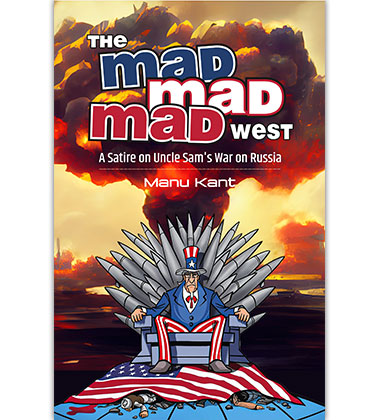
The Mad, Mad, Mad West by Manu Kant is a work of political satire that attacks contemporary imperialism, especially the role of the United States and its NATO allies in the Ukraine–Russia war. Written in simple, sharp, and often exaggerated language, the book tries to expose what it sees as the irrational, hypocritical, and aggressive character of Western imperialist politics.
From a Marxist standpoint, the central question is not style but class content. Every war must be judged by asking: which class forces are behind it, and what material interests are being served? The book clearly takes the position that the present conflict is not a neutral or moral struggle, but part of a long-term strategy of U.S. imperialism to encircle, weaken, and ultimately dominate Russia. In this sense, it aligns with the Marxist understanding that modern imperialism, led by the United States, continues to seek global hegemony through military alliances, economic sanctions, and ideological warfare.
The satire in the book works as a political weapon. By exaggerating news reports, statements of leaders, and media narratives, it reveals how truth itself is manipulated. Western media is shown not as an independent force, but as an instrument of the ruling class. Facts are twisted, language is distorted, and even basic logic is sacrificed to justify imperialist goals. This is consistent with the Marxist understanding that the dominant ideas in any society are the ideas of the ruling class. The book repeatedly drives home the point that “truth” under imperialism is not objective, but shaped by power.
Another important aspect of the book is its attack on the cultural arrogance of the West. Through satire about banning Russian writers, canceling culture, and promoting racial superiority, the author exposes how imperialism is not only economic and military, but also ideological. It tries to dominate minds. It defines what is “civilised” and what is “barbaric.” From a Marxist angle, this reflects the superstructure of imperialism, where culture, education, and media serve to justify exploitation and aggression.
The book also highlights the double standards of imperialist politics. Wars led by the West are presented as struggles for democracy, while resistance to Western dominance is labeled aggression. Sanctions that harm ordinary people are justified in moral language. Racism, which is deeply embedded in imperialist history, appears again in subtle and open forms. The satire captures these contradictions effectively and makes them visible to the common reader.
However, from a strict Marxist position, certain limitations must be pointed out. While the book strongly attacks U.S. imperialism, it tends to present Russia mainly in a defensive light. This creates a risk of political imbalance. Marxism–Leninism teaches that present-day Russia is not a socialist state but a capitalist one, with its own ruling class and interests. Therefore, while it may be in conflict with U.S. imperialism, it cannot be seen as a progressive or revolutionary force. The correct line is to oppose imperialism, especially its most aggressive form, without falling into support for another bourgeois state.
At times, the satire becomes so exaggerated that it may blur class clarity. Instead of clearly showing the class character of all sides, it may appear as if one side is entirely irrational and the other entirely justified. This can weaken the scientific analysis required in Marxism. Satire is a powerful tool, but it must remain grounded in materialist understanding.
Despite these limitations, the book performs an important function. It breaks the illusion created by mainstream narratives. It encourages readers to question what they are told. It exposes the connection between power and truth. In a time when propaganda is widespread and often subtle, such sharp and direct writing can help awaken political consciousness, especially among those who are not deeply engaged with theory.
In conclusion, The Mad, Mad, Mad West can be seen as a satirical critique of imperialism that reflects many key insights of Marxist–Leninist analysis, particularly regarding propaganda, ideology, and global power struggles. At the same time, it requires careful reading to maintain correct class understanding and avoid one-sided conclusions. Properly understood, it can serve as a useful entry point for recognizing the workings of imperialism in the modern world.
In essence: a politically sharp satire that exposes imperialist hypocrisy, but must be read with firm class clarity.







Book Bazooka Publication बुक बज़ूका पब्लिकेशन
