 Chat with us
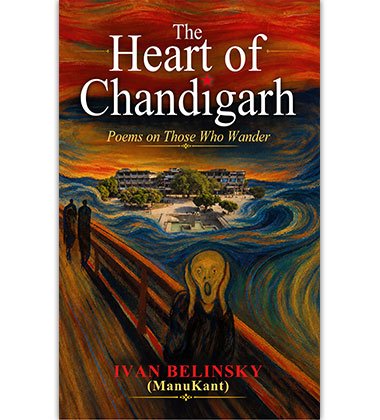
A Marxist-Leninist-Stalinist Reading of the Poems of Ivan Belinsky (Comrade Manu Kant)
The poems of Ivan Belinsky (Comrade Manu Kant) are a sustained literary examination of human beings pushed to the margins of social existence. Written largely from the streets, markets, restaurants and public spaces of Chandigarh, particularly Sector 17, they observe homeless people, mentally disturbed people, workers, children, shopkeepers, restaurants, municipal programmes, psychiatric institutions, birds, waste bins, clothing shops and the countless small details of everyday urban life.
Read from a strict Marxist-Leninist-Stalinist perspective, these poems are not merely poems about individual suffering. They are poems about the social production of suffering.
Their central concern is the human being under class society.
The poems repeatedly return to a fundamental contradiction. Modern society possesses enormous productive powers. It produces food, clothing, medicines, buildings, restaurants, cafés, consumer goods and highly organised cities. Yet human beings can remain hungry, homeless, isolated, untreated, socially abandoned and deprived of meaningful participation in collective life.
Sector 17 becomes, in this sense, more than a location.
It becomes a small stage upon which the contradictions of capitalist society can be observed.
A person searches through waste bins while commodities circulate everywhere around him. A hungry man comes repeatedly to the door of a restaurant. A man asks for thicker clothing because he feels cold at night because he does not eat properly. A person who has fallen outside ordinary social life remembers photography as his profession and passion.
The contradiction is material.
There is abundance, but there is not universal access to abundance.
There is production, but there is not necessarily production for human need.
There are commodities, but there are human beings who remain deprived of the commodities necessary for ordinary existence.
This is where the poems acquire their distinctly Marxist character.
The human being before the theory
One of the greatest strengths of Ivan Belinsky's poetry is that he does not begin with abstract political formulas.
He begins with people.
A man carries a cold coffee cup while moving from one waste bin to another.
A man waits outside a restaurant because hunger brings him there.
A man chooses a T-shirt carefully.
A man asks about the shampoo before his hair is washed.
A man asks the barber to preserve his sideburns.
A man sprays perfume from the pocket of his discarded clothing.
A man asks whether he is recognised.
A man remembers his former profession.
A man speaks Urdu.
A man speaks Russian.
A man remembers a Russian girlfriend.
A man talks about photography.
These details are extraordinarily important.
The poet refuses to allow the socially marginalised person to become merely a category.
He remains a human being.
He has tastes.
He has memories.
He has vanity.
He has humour.
He has desires.
He has cultural knowledge.
He has a past.
He has an idea of a possible future.
The capitalist city may see him as a nuisance, a beggar, a mentally ill person or an anonymous figure in a public place.
The poem sees a person.
That is one of the collection's most important acts.
Mental illness as a social question
The poems adopt a particularly strong materialist position on mental illness.
Within the strict Marxist framework underlying this collection, mental illness is understood fundamentally through the social and material environment in which human beings live. It is not treated as an isolated defect existing independently of society.
Class society subjects human beings to exploitation, insecurity, alienation, competition, poverty, unemployment, humiliation, family disintegration, social isolation and other forms of social pressure. A capitalist society can therefore generate conditions profoundly hostile to healthy human development.
From this perspective, what bourgeois society tends to present as an exclusively individual problem can also be examined as a social problem.
The question is not merely: What is wrong with this individual?
The Marxist question is: What kind of social environment produces such forms of human suffering, and what social relations reproduce them?
The collection repeatedly directs attention toward that question.
It does not present the mentally disturbed person as an isolated biological curiosity.
It places him in the middle of a social world.
He is hungry.
He is homeless.
He is separated from family.
He has lost ordinary work.
He has been pushed outside normal social relationships.
He encounters institutions.
He encounters public spaces, restaurants, markets and strangers.
His consciousness is therefore presented within concrete social conditions.
That is fundamentally different from an approach that isolates the individual from society.
Class society and the production of alienation
Marxism's concept of alienation becomes particularly useful in understanding these poems.
The collection repeatedly presents people who appear separated from ordinary forms of human social existence.
They are separated from stable work.
They are separated from secure housing.
They are separated from family.
They are separated from regular consumption.
They are separated from social recognition.
They are separated from participation in collective life.
The result is not simply poverty.
It is social alienation.
The individual remains physically present but increasingly disappears from the social world.
This is why the question,
“Do you recognise me, uncle?”
is so powerful.
Recognition is itself a social relation.
The man wants to know whether another human being still sees him as someone who exists.
The answer is therefore not merely emotional.
It has a social meaning.
A person who has become almost invisible to society seeks confirmation that he remains visible to another human being.
The waste bin and the commodity
One of the most powerful images in the collection is the young man moving from one waste bin to another with a cold coffee cup in his hand.
The image contains an entire social contradiction.
The coffee is a commodity.
It has been purchased, consumed and discarded.
The man remains outside the normal commodity relation.
The discarded object has entered the waste stream while the human being is still searching through it.
This reversal is deeply materialist.
Capitalism produces an extraordinary quantity of objects, yet the distribution of those objects remains mediated by class relations and purchasing power.
The existence of food does not mean that everybody eats.
The existence of clothing does not mean that everybody is adequately clothed.
The existence of housing does not mean that everybody has a home.
The existence of medical institutions does not mean that everybody receives social care in conditions of dignity.
The poems repeatedly reveal precisely this contradiction.
Hunger
The poems about food are among the most Marxist in the collection because they return repeatedly to the most elementary material fact of human existence.
Hunger.
The statement that hunger brings the man every night to the door of Ghazal Restaurant is devastating precisely because it is so simple.
Hunger is not an abstract philosophical condition.
It is physiological.
It is material.
It is measurable.
It forces a human being towards food.
Likewise, the statement that he has not had such a restaurant meal for eight years immediately transforms the restaurant from an ordinary commercial establishment into a symbol of social inequality.
For one person, a restaurant meal is routine.
For another, it is an event remembered for years.
The same city contains both realities.
Clothing, warmth and the material body
The clothing poems extend the same argument.
The man chooses a T-shirt and asks for thicker cloth because he feels cold at night.
He explains that he does not eat properly.
The body therefore reveals the social condition.
Hunger produces weakness.
Insufficient food makes cold more difficult to endure.
Clothing becomes a matter of survival rather than fashion.
Yet the man still chooses his clothing carefully.
This is an important contradiction.
Material deprivation does not eliminate individuality.
Even under severe deprivation, the human being remains concerned with appearance, comfort, dignity and self-presentation.
That is why the perfume, shampoo, beard, sideburns and clothing poems are so important.
They show the persistence of human individuality within social degradation.
The lost worker
Perhaps one of the most revealing moments occurs when the man is asked whether he was really a photographer.
He answers that photography was his profession and his passion.
That statement opens an entirely different dimension.
He is no longer simply a homeless person.
He is a former worker.
He possessed a skill.
He had an occupation.
He had an identity connected with productive activity.
He had a passion.
And he still imagines returning to photography.
The social tragedy is therefore not simply that he lacks money.
A whole relationship with productive social life appears to have been broken.
The man has not ceased to possess human capacities.
Those capacities have become socially disconnected from ordinary life.
This is one of the clearest points at which the poetry moves beyond sentimental pity towards a materialist understanding of human degradation.
Sector 17 and capitalist modernity
Sector 17 is particularly appropriate as the setting for these poems.
It represents planned urban modernity.
It contains commercial establishments, restaurants, public spaces, cultural programmes, clothing shops and consumer goods.
Yet the same space contains people who live outside the ordinary structures of that modernity.
This produces a striking contradiction.
The planned city has order.
Human life does not necessarily have order.
The market is functioning.
Yet a human being is hungry.
The shops are functioning.
Yet a person does not have adequate clothing.
Restaurants are functioning.
Yet a person can go years without a proper meal.
Municipal authorities celebrate cleanliness.
Yet socially abandoned human beings remain visible in the very public spaces being celebrated.
The contradiction does not have to be explained through slogans.
It is visible.
Swachhata and social invisibility
The poem involving municipal banners for Swachhata and a music programme in Sector 17 is particularly effective.
The public space celebrates cleanliness, civic order and urban culture.
Meanwhile, a mentally disturbed man sits on a bench after eating a patty and listens to the music.
The contrast is almost cinematic.
The city is concerned with the appearance of public order.
The poem asks, without explicitly asking, what happens to the human beings who do not fit that order.
This is a recurring concern throughout the collection.
Capitalist society is highly capable of organising commodities and spaces.
It is much less capable of integrating every human being into a secure social existence.
The dignity of the marginalised
The poems refuse another common mistake.
They do not portray the marginalised person as completely passive.
He chooses.
He remembers.
He jokes.
He speaks.
He asks questions.
He expresses religious beliefs.
He talks about women.
He remembers Russia.
He knows Russian.
He values Urdu.
He remembers photography.
He chooses food.
He chooses clothing.
He cares about his appearance.
He asks whether he is recognised.
He even tells the poet that living in Sector 16 makes him an important person.
The relationship therefore becomes reciprocal.
The poet is not merely helping an anonymous victim.
He is interacting with a person capable of observing him, judging him and giving him advice.
That reciprocity gives the poems their humanity.
“Urdu is a language of love”
The statement,
"Urdu is a language of love, it is the language of songs,” is one of the collection's most beautiful moments.
The man who has been socially reduced to the category of “mentally ill” suddenly becomes the person articulating a philosophy of language.
He teaches the poet something.
This reversal is important.
The poet does not possess all knowledge.
The marginalised person is also a bearer of culture.
He has an aesthetic consciousness.
He has an emotional relationship with language.
He possesses something that the supposedly normal social world has failed to see.
Recognition
The repeated question,
“Do you recognise me, uncle?”
deserves special attention.
It is one of the simplest and most profound questions in the collection.
Recognition is a fundamental social need.
A person can lose possessions.
He can lose employment.
He can lose his home.
He can lose contact with his family.
But there is another loss which is less visible: the loss of being recognised as a person.
The poem restores that recognition.
The poet remembers him.
The man therefore exists within another person's consciousness.
The act of writing becomes an act of social memory.
Family and abandonment
The poems repeatedly ask about parents.
Where are they?
Why did they leave?
Why was he abandoned?
The answers are sometimes direct and sometimes mysterious.
“In my heart.”
“The answer is written in the sky.”
The poet wisely does not explain everything.
The unanswered question itself becomes part of the social tragedy.
Family is normally one of the basic institutions through which human beings receive protection, identity and material support.
When that relation breaks down, the individual can become extraordinarily vulnerable.
The poems therefore repeatedly return to the absent mother and absent family.
The old Hindi film songs intensify this theme.
Popular songs and class memory
The songs used throughout the collection are not ornaments.
They are part of the social consciousness of an entire generation.
Manna Dey, Kishore Kumar, Sahir Ludhianvi, Majrooh Sultanpuri and other figures of popular Hindi cinema enter the poems through remembered songs about mothers, fathers, love, betrayal, loneliness and the passage of life.
This is culturally important.
The working and middle classes do not encounter culture only through formal literature.
They encounter it through cinema and popular song.
A song can remain in collective memory for decades.
By placing these songs beside the lives of abandoned people, Kant connects the marginalised individual to a much larger cultural history.
The man is not outside Indian society altogether.
He carries pieces of its culture within himself.
The sky, birds and religion
The poems frequently turn towards the sky, birds and religion.
The man talks to pigeons.
He calls the squirrel his friend.
He looks at the sky.
He says that God is watching over him.
He prays behind the Gymkhana Bar.
A strict materialist reading does not require these beliefs to be mocked.
Religion is itself a social product and a form of consciousness.
A person who has experienced insecurity and abandonment may seek meaning, consolation and protection in religious belief.
The Marxist task is not simply to laugh at the belief.
It is to understand the material conditions within which such consciousness arises.
The poems are strongest when they observe rather than lecture.
Psychiatric institutions
The psychiatric poems introduce another dimension of social power.
Haloperidol, psychiatric wards, medication, forced routines and the patient's own experience of being slowed down appear in the collection.
The poet's own psychiatric memories are especially significant.
He remembers being a patient himself.
He remembers the psychiatrist.
He remembers the injection.
He remembers his own disturbed consciousness.
This prevents him from adopting the comfortable position of the supposedly normal observer examining abnormal people.
He has himself occupied the other side of the institutional boundary.
From a Marxist perspective, this raises the question of who possesses the authority to define normality.
The institution possesses medical knowledge and legal authority.
The patient possesses his own subjective experience.
The contradiction between the two is real.
A materialist analysis should examine the social conditions of psychiatric care, the power of institutions and the experiences of patients rather than reducing the issue to either blind faith in institutions or the claim that every form of psychiatric treatment is simply repression.
The poet and the individual act of solidarity
Kant repeatedly feeds the man, takes him to restaurants, takes him to the barber, accompanies him to clothing shops and talks with him.
These acts matter.
But the poems also reveal their limits.
One individual can feed another individual.
One person can provide clothing.
One person can listen.
One person can provide companionship.
But individual charity cannot abolish the social conditions producing mass poverty, homelessness, alienation and social exclusion.
This is where the poems move beyond liberal humanitarianism.
They contain compassion, but their deepest questions are social.
The poet's personal relationship with the man becomes a window through which the reader sees a much larger social structure.
The question of empathy
One poem says that the problems of the world arise from a lack of empathy for fellow human beings.
As a moral statement, this is understandable.
But a strict Marxist analysis must go further.
Capitalism cannot be explained simply by individual selfishness.
The capitalist is not merely an unusually selfish individual.
Capitalist competition compels accumulation.
The worker must sell labour-power in order to survive.
Production is organised around social relations in which the means of production are privately controlled.
Consequently, even individual kindness cannot abolish the structural relations of capitalist society.
This distinction strengthens rather than weakens the humanitarian impulse of the poems.
The problem is not simply that people need to become kinder.
The deeper problem is that human relations themselves must be transformed.
“I Wonder About Them”
The longer poem “I Wonder About Them” perhaps contains the central question of the entire collection.
It asks where such people sleep.
How they survive winter.
How they survive summer.
Whether they remember their parents.
Whether they remember their children.
Whether old faces return to them.
Whether they wait for someone.
Whether they still carry their names.
And finally it asks whether, in the fragments of their speech and the silence between them, there is a life and a story that society has chosen not to see.
This is the central act of the poetry.
It makes the invisible visible.
The person who has become background scenery in the capitalist city becomes the subject of poetry.
The dodo
The dodo poem makes the political argument explicit.
The dodo became extinct.
The mentally disturbed will not.
The comparison is deliberately provocative.
The dodo disappeared as a species.
Human beings who suffer social and psychological breakdown remain part of society, but the conditions producing their suffering can continue indefinitely.
The poem therefore shifts the question from individual tragedy to social reproduction.
The question is no longer simply why one person suffers.
It becomes: Why does society repeatedly reproduce the conditions under which human beings can be abandoned?
The final silence
The final sequence involving the Manoj Kumar song is especially powerful.
The poet asks once again why the man left home and why his parents abandoned him.
The man says that it is a long story.
The song plays.
Its words concern betrayal, suffering and the unreliability of human relationships.
The man looks towards the sky.
The song ends.
The poet stops.
That final act of stopping is artistically important.
The poet does not explain the man's entire life.
He does not provide a political speech.
He does not tell the reader what emotion to feel.
He leaves the contradiction standing.
This is where the poetry is strongest.
Socialist realism through concrete detail
The collection's strongest poems share a common method: observation, contradiction, silence.
They do not begin with theory.
They present a material fact.
The reader sees it.
Then the contradiction emerges.
A waste bin.
A cold coffee cup.
A hungry man outside a restaurant.
A thick T-shirt.
A bottle of perfume.
A barber's shampoo.
A forgotten profession.
A cigarette packet.
A municipal banner.
A psychiatric ward.
A song.
A question about recognition.
The concrete detail becomes the vehicle of social criticism.
This gives the poetry a documentary quality, but it also gives it literary strength.
The poems are not newspaper reports.
They are compressed social observations.
The central contradiction
The entire collection can ultimately be understood through one fundamental contradiction: the degradation of the human being under class society versus the persistence of human dignity.
The man is hungry, but he chooses his clothes.
He is homeless, but he remembers photography.
He is isolated, but he seeks friendship.
He is disturbed, but he speaks about language.
He has suffered, but he jokes.
He is marginalised, but he asks whether he is recognised.
He has lost his former life, but he still imagines photographing again.
He is socially abandoned, but he remembers songs, women, countries and languages.
The social system may classify him.
The poem restores his individuality.
The poems of Ivan Belinsky (Comrade Manu Kant) should therefore not be read simply as poems about mental illness.
They are poems about human beings under class society.
They are poems about hunger, commodities, labour, alienation, family, homelessness, psychiatric institutions, social exclusion, popular culture, memory and human dignity.
They are poems about the contradiction between a society capable of producing enormous material wealth and a social order in which human beings can nevertheless remain deprived of the basic conditions necessary for a full human existence.
The collection's Marxist-Leninist-Stalinist significance lies precisely in its insistence upon beginning with concrete human life.
A man searches a waste bin.
A hungry man waits outside a restaurant.
A man asks for thicker clothing.
A former photographer remembers his profession.
A man asks: “Do you recognise me, uncle?”
Another says: “Urdu is a language of love.”
Another remembers Russia.
Another looks towards the sky.
And the poet watches.
The poetry gives these people something that society has increasingly denied them:
visibility.
It gives them names, voices, memories and histories.
It refuses to treat them merely as social debris.
It places their suffering within the material conditions of society and, at the same time, insists that even in extreme degradation the human being retains desires, memories, humour, culture and dignity.
That is the deepest humanistic and materialist impulse of the collection.
Its fundamental question is therefore not simply: What is wrong with this individual?
It is the far more fundamental Marxist question:What kind of class society produces the conditions in which a human being can possess all these capacities, memories and desires, yet still end up hungry, homeless, socially isolated and almost invisible in the middle of a prosperous modern city?
The poems do not merely answer that question.
They make the reader see it.







Book Bazooka Publication बुक बज़ूका पब्लिकेशन
