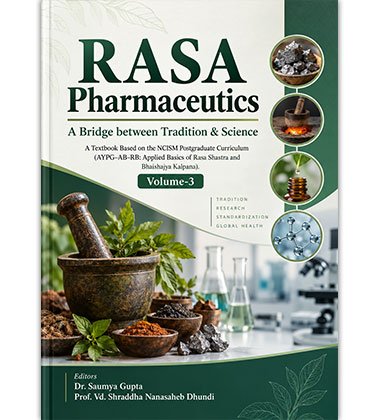
RASA Pharmaceutics: A Bridge between Tradition & Science
A Textbook Based on the NCISM Postgraduate Curriculum (AYPG–AB–RB: Applied Basics of Rasa Shastra and Bhaishajya Kalpana). Volume-3
Authors: Prof. Vd. Shraddha Nanasaheb Dhundi, Dr. Saumya Gupta
RASA Pharmaceutics: A Bridge Between Tradition & Science (Volume 3) is an authoritative, advanced academic guide systematically designed to synthesize classical Ayurvedic pharmaceutical doctrines with modern pharmaceutical, chemical, and analytical paradigms. Developed in precise alignment with the National Commission for Indian System of Medicine (NCISM) curriculum for postgraduate studies (AYPG–RB: Applied Basics of Rasa Shastra and Bhaishajya Kalpana, Semester 3), this volume delivers an exhaustive, evidence-based exploration spanning the entire Semester 3 syllabus across Papers 1, 2, 3, and 4.
Integrating fundamental concepts with contemporary translational research, the text provides postgraduates, academicians, pharmaceutical researchers, and industry professionals with a definitive roadmap from classical material identification to novel computational drug design.
Key Curricular Highlights & Thematic Modules
Paper 1: Rasashastra (Iatrochemistry) — Principles and Practices
- Module 1 (M-1): Chronological Development & Taxonomy of Rasa Dravyas: Covers the philosophical relevance of Raseshwara Darshana, the historical evolution of Rasashastra from the pre-Vedic era through modern iatrochemistry, and the systematic classification of minerals, metals, gems, and poisons. It provides comprehensive organoleptic (Grahya-Agrahya Lakshana) and mineralogical keys for raw drug authentication alongside Mendeleev’s periodic table correlations, resolving classical ambiguities surrounding Sandigdha (controversial), Anupalabdha (unavailable), Krutrima (artificial), and Pratinidhi (substitute) substances.
- Module 2 (M-2): Puta & Samskara (Transformative Operations): Integrates classical incineration systems with thermodynamics, thermochemistry, Griffith's fracture theory, and collision kinetics. It provides standard operating procedures (SOPs) and mechanistic insights for advanced mercurial and mineral operations, including Jarana, Amritikarana, Lohitikarana, Satva Patana, and Druti, alongside the operational influences of Desha (geography), Kala (temporal factors), Kalaprakarsha (processing duration), and Bhajana (reaction vessels).
Paper 2: Exposition of Ayurvedic Pharmaceutics
- Module 9 (M-9): Scientific Fundamentals of Ayurvedic Pharmaceutical Preparations: Explores the scientific basis of Panchavidha Kashaya Kalpana and Upakalpana, raw material quality control (GACP, WHO/AYUSH limits, adulteration, and contamination), process optimization parameters, and traditional endpoints (Siddhi Lakshana) correlated with modern spectroscopic and chromatographic benchmarks (XRD, TEM/SEM, HPLC, LC-MS).
- Module 10 (M-10): Principles of Pharmaceutical Formulation: Delves into the philosophy of Samskara in drug development, modern dosage form design (preformulation, biopharmaceutics/BCS classification, and pharmacokinetics/ADME), rational polyherbal combinations, functional excipients, Prakshepa Dravya dynamics, and classical (Shaktyutkarsha) and modern potency enhancement technologies.
Paper 3: Standardization and Clinical Utility of Ayurvedic Formulations
- Module 17 (M-17): Guidelines for Administration of Rasoushadhi in Clinical Practice: Features classical clinical safety guidelines, Kshetrikarana purificatory protocols prior to mineral administration, Pathya-Apathya dietary regimens, pharmacovigilance, the clinical management of Apakwa and Ashuddha Bhasma toxicity, and heavy metal toxicokinetics integrated with contemporary chelation therapy.
- Module 18 (M-18): Prayogika Bhaishajya Kalpana (Clinical Application): Details the clinical science of Aushadha Sevana Kala (chronopharmacology and biological rhythms), the bio-enhancing and targeted delivery mechanisms of Anupana, patient-centric Matra (posology and pediatric dose calculations), and modern drug repurposing strategies.
Paper 4: Regulatory Aspects and Recent Trends in Ayurvedic Pharmaceutics
- Module 25 (M-25): Artificial Intelligence in Drug Development & Pharmacogenomics: Discusses emerging frontiers in computational drug design, generative models for de novo discovery, machine learning in ADMET prediction, 3D-printed personalized drug delivery systems based on natural products, and pharmacogenomics in targeted therapeutics.
- Module 26 (M-26): Pharmacology: Provides core grounding in modern medical pharmacology, focusing on pharmacodynamics, receptor kinetics, dose-response curves, pharmacokinetics, adverse drug reactions, and systemic pharmacology covering the autonomic, peripheral, and central nervous systems (neurotransmitters, anesthetics, psychopharmacological agents, and nootropics).
This volume stands as an indispensable companion for postgraduate scholars preparing for university examinations, doctoral researchers exploring interdisciplinary Ayurvedic pharmacology, and manufacturing leaders committed to elevating the quality, safety, and global validation of Ayurvedic formulations.
 Chat with us